
India created history on Wednesday when the lander module of Chandrayaan-3 touched down on the lunar south pole, propelling the country to an exclusive club of four and making it the first country to land on the uncharted surface.

Chandrayaan-3 mission's rover 'Pragyan' has traversed a distance of about eight metres on the lunar surface, and its payloads have been turned on, ISRO said on Friday.

Weighing 320 tonne at lift-off, the vehicle used larger strap-on motors to achieve higher payload capability.

The Chandrayaan-2 mission has made the first-ever observation of the effects of the Sun's Coronal Mass Ejection (CME) on the Moon using its onboard scientific instruments. This observation would help understand the lunar exosphere and the impact of space weather on its surface.
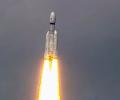
The Chandrayaan-3 mission that aims for a soft landing on the moon's surface, paving the way for future interplanetary missions, carries six payloads that would help ISRO understand the lunar soil and also get the blue planet's photographs from the lunar orbit.
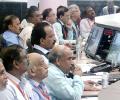
Leading scientists and experts said this monumental accomplishment not only marks India's indelible imprint on lunar exploration but also demonstrates the prowess of human collaboration, determination, and cutting-edge technology.

The Indian space agency is all set to embark on its most complex mission.

ISRO Chairman S Somanath had recently said the most critical part of the landing will be the process of reducing the velocity of the lander from 30 km height to the final landing, and the ability to reorient the spacecraft from horizontal to vertical direction. "This is the trick we have to play here," he said.
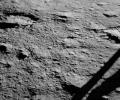
The lessons learned from the failure of Chandrayaan-2 contributed to the success of India's third lunar mission, former space scientist with the Indian Space Research Organisation (ISRO) Nambi Narayanan said, after the successful touchdown of the 'Vikram' lander on the lunar South Pole.

The US astronaut reflected on the importance of international cooperation in space missions like these.
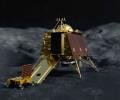
A complaint was lodged against the accused Mitul Trivedi, after he was seen giving interviews to the local media since the Vikram lander successfully made soft landing on August 24, claiming to have designed the lander module of Chandrayaan-3, the official said.

Vikram (with rover 'Pragyan' housed inside) is expected to touch down on the lunar surface on September 7, between 1.30 am and 2.30 am.

Somanath thanked all those who prayed for the mission's success, and ISRO veterans like A S Kiran Kumar , the space agency's former chief.

People gathered in educational institutions, offices, city squares and religious places to watch the Indian Space Research Organisation's live telecast of Chandrayaan-3's final descent to the uncharted surface of the lunar south pole.

Prime Minister Narendra Modi was accorded a warm reception as he arrived at the Indian Space Research Organisation headquarters in Bengaluru on Saturday morning.

Subramanian, 33, who was on Tuesday the toast of the astronomy world, managed what ISRO and NASA couldn't through his close examination of before and after images of the scheduled landing.
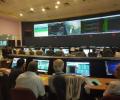
"Already, orbiter is in space and it should do an excellent job of mapping," Nair said.

The entire mission operations of Chandrayaan-3, right from the launch till landing, "happened flawlessly" as per the timeline, the team that led India's third mission to the Moon said on Wednesday.

India will become the fourth country to master the technology of soft-landing on the lunar surface after the US, China and the erstwhile Soviet Union.

The precise location of the spacecraft in the lunar highlands has yet to be determined.

The entire process being autonomous when the lander has to fire its engines at the right times and altitudes, use the right amount of fuel, and scan of the lunar surface for any obstacles or hills or craters before finally touching down.

The mission objectives of Chandrayaan-3 are to demonstrate a safe and soft landing on the lunar surface, to demonstrate rover roving on the Moon, and to conduct in-situ scientific experiments.
NASA's Lunar Reconnaissance Orbiter spacecraft has snapped a series of images during its flyby on September 17 of Vikram's attempted landing sight near the Moon's uncharted south pole.

August 23, the day the Chandrayaan-3 lander touched down on the lunar surface, would be celebrated as 'National Space Day'.

Hours before Chandrayaan-2's 'Vikram' module's proposed soft landing on the Lunar surface, Indian Space Research Organisation chairman K Sivan said on Friday things are progressing as per plan for the much-awaited event.
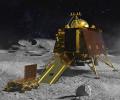
ISRO chairman K Sivan said the proposed soft-landing was going to be a 'terrifying' moment.

Film folk like Akshay Kumar, Chiranjeevi, Jr NTR and Sunny Deol congratulated the country and the Indian Space Research Organisation (ISRO) on the historic achievement of Chandrayaan-3's landing on the Moon.

Former National Aeronautics and Space Administration (NASA) Official Mike Gold has said Chandrayaan-3's success is a triumph of Indian innovation, human capital and the capabilities that will take India even further.
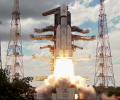
New data from India's Chandrayaan-3 mission suggests that ice might be present at more locations on the Moon's surface than previously believed. The study, published in Communications Earth and Environment, analyzed temperature data collected by the ChaSTE probe onboard the Vikram lander. The researchers found that significant variations in surface temperatures can influence the formation of ice, with slopes angled away from the Sun potentially providing favorable conditions for ice accumulation. The findings have implications for future lunar exploration, suggesting that water-ice resources could be more accessible than previously thought.
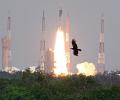
The nine-second de-orbiting or retro-orbiting manoeuvre was executed at 3.42 am using the onboard propulsion system.
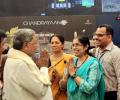
Even as the scientists and staff at Mission Operations Complex broke into applause, the core team members thanked all those who had worked on the mission. Quietly and without jingoistic boasting of their stupendous achievement. And that is the most remarkable aspect of ISRO -- they let their work do the talking, notes Minnie Vaid, author of Those Magnificent Women And Their Flying Machines, ISRO's Mission to Mars.

The mission has three modules - Orbiter, Lander (Vikram) and Rover (Pragyan)
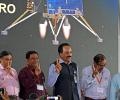
Ex-ISRO chairman G Madhavan Nair said the scientists at space agency have achieved this historic success by getting a salary one-fifth of the scientists in the developed world.

India on Wednesday joined an elite group of three nations to have sent a spacecraft on the Moon, as Chandrayaan-3 landed a rover on the lunar surface to explore the uncharted territories near the south pole.

Singh also said a final decision on the launch of India's sun mission 'Aditya-L1', scheduled for September 2 at present, will rest on the prevailing cosmic aspects.

'There's nothing like failure in science, we experiment & we gain'
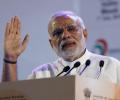
I urge you all to watch the special moments of Chandrayaan-2 descending on to the Lunar South Pole! Do share your photos on social media. I will re-tweet some of them too," the prime minister wrote on Twitter.

This image features the left image within the red channel, and the right image within the blue and green channels, resulting in a striking cyan hue.
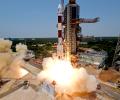
The successful launch of Aditya-L1 - the country's maiden mission to study the Sun - is expected to garner increased investor interest in the Indian space sector and trigger more funding for private players. Several private sector players, including Larsen & Toubro (L&T), MTAR Technologies, and Ananth Technologies, have played a pivotal role in the Indian Space Research Organisation's (Isro's) solar observatory mission. Aditya-L1 on Saturday set off on a 125-day journey on a PSLV-C57 rocket, in its attempt to study various elements relating to the nearest star from the halo orbit around Lagrange point 1 (L1) of the Sun-Earth system, which is about 1.5 million km from Earth.

The landing on the moon near the South Pole, an uncharted territory so far, would be on September 6 or 7, Sivan told reporters, as the Indian space agency is all set to embark on its most complex mission.
